Portal | HRM | Email | LMS | Exam | Procedures Manual | Student Exchange | Repository | Research Journal | Jobs | 


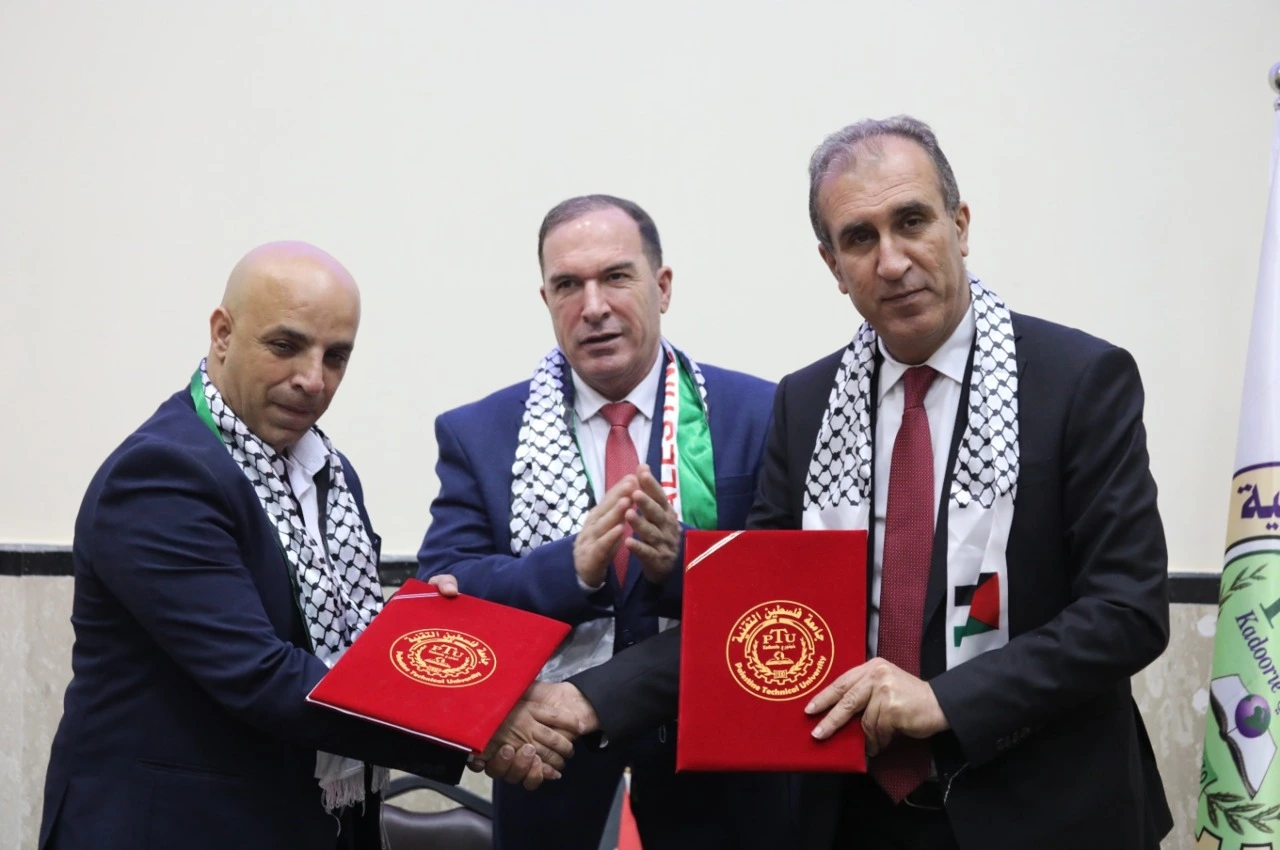
Palestine Technical University – Kadoorie (PTUK) signed a partnership and cooperation agreement with the General Intelligence Department of the Palestinian Police, in the presence of Tulkarm Governor Major General Dr. Abdullah Kamil; PTUK President Prof. Hussein Shanak; and Director General of the General Intelligence Department Brigadier General Mohammad Al-Kaswani.
The agreement aligns with PTUK’s policy of strengthening national partnerships and steering research toward societal needs, reinforcing the integration of academic knowledge with practical application and consolidating the University’s role as a driver of development, innovation, and public service.
The system aims to enhance economic protection, curb illegal practices and tax evasion, and combat theft, underscoring the University’s commitment to aligning research with the needs of national institutions to advance community security and sustainable development.
The Gold Track System is a centralized digital platform designed to automate and monitor gold purchase transactions, enhance oversight and transparency, and enable early detection of suspicious activities. The project was developed by students Dana Al-Sayyed and Hiba Khalil under the supervision of Dr. Mohammad Khalil.
In his remarks, Prof. Hussein Shanak emphasized that the agreement reflects the University’s vision of directing knowledge toward national priorities and strengthening institutional integration. He noted that PTUK views education not merely as theoretical coursework, but as a comprehensive pathway for producing applied knowledge capable of addressing real-world challenges.
He highlighted a capstone project developed by Computer Engineering students under the supervision of Dr. Mohammad Khalil, which resulted in a computerized system to manage and regulate the gold and precious metals sector in coordination with the General Intelligence Department.
Governor Dr. Abdullah Kamil conveyed greetings from President Mahmoud Abbas and stressed the importance of such agreements as an advanced model of cooperation between security institutions and academia.
He underscored the role of science and innovation in serving citizens and reaffirmed that the police operate in the service of the public, particularly in the face of current challenges that necessitate unity and institutional cohesion.
Brigadier General Mohammad Al-Kaswani affirmed that the agreement marks a significant step toward deeper integration between academic and security institutions. He emphasized the value of knowledge exchange, research collaboration, and capacity building to address security challenges through scientific and systematic approaches.
He added that the computerized system for managing the gold sector will enhance oversight, transparency, and regulatory efficiency, safeguarding the rights of citizens and traders while reinforcing the rule of law.
Saed Hawari, Head of the Goldsmiths’ Syndicate, described the partnership as a strategic step toward regulating and protecting the gold sector.
He noted that digitizing transactions and linking them with relevant authorities strengthens market confidence, limits violations and unlawful evasion, and provides a fair regulatory framework for compliant traders, commending the University and its students for developing technological solutions that support the national economy.