Portal | Application for Admission | HRM | Email | LMS | Exam | Procedures Manual | Student Exchange | Repository | Research Journal | Jobs | 



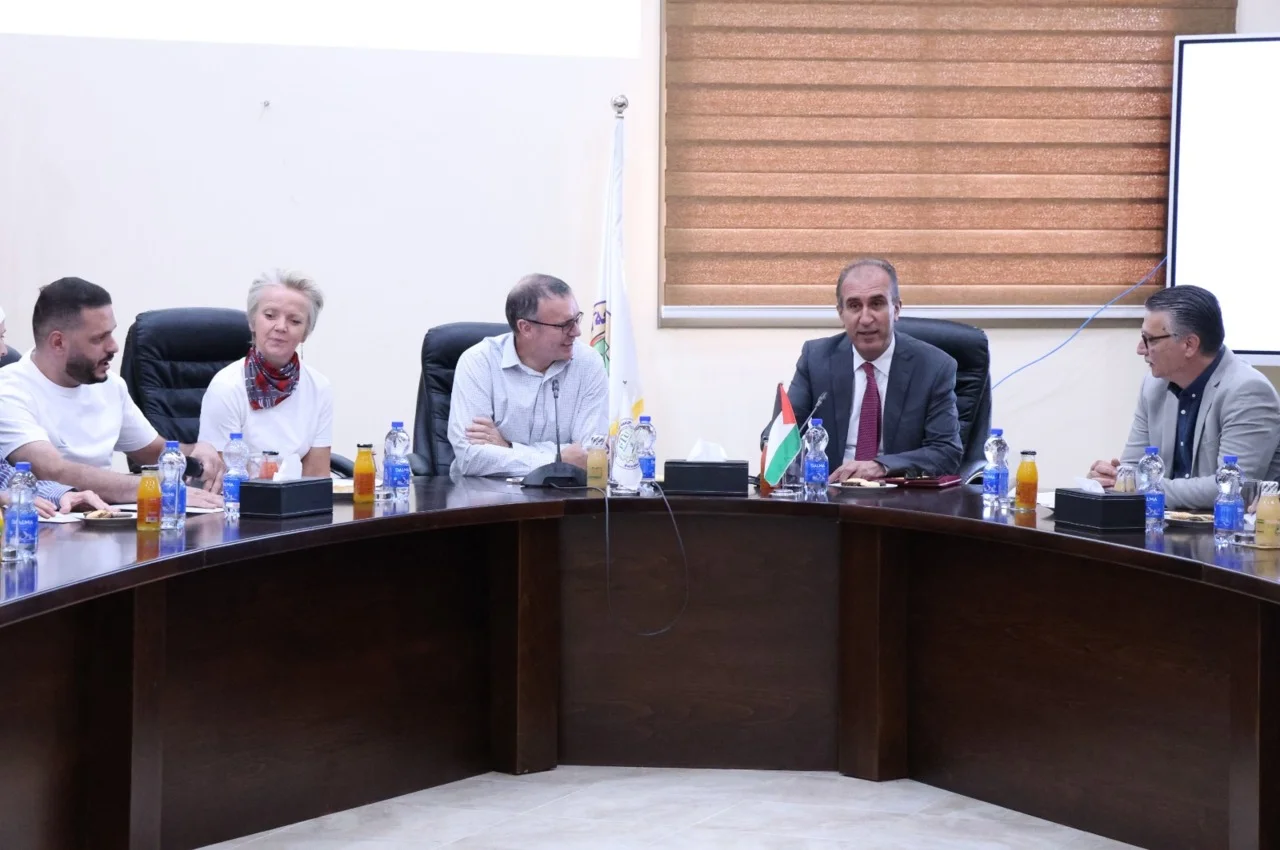
In his opening address, University President Prof. Hussein Shanak warmly welcomed the delegation and expressed sincere appreciation for the continuous support provided by international and national partners. Prof. Shanak emphasized PTUK’s deep commitment to environmental research, noting that establishing clean air quality monitoring systems directly impacts public health and community well-being.
He affirmed the university’s full readiness, state-of-the-art facilities, and academic capacity to sustain the network. Highlighting the educational dimension, Prof. Shanak underscored that this initiative equips PTUK students with hands-on technical skills, ensuring that the project delivers tangible, localized solutions that directly serve Palestinian communities rather than remaining an abstract global effort.
Representing the UNDP/PAPP senior leadership, Special Representative Mr. Jaco Cilliers commended the university and project partners for executing such impactful scientific work under remarkably difficult circumstances. Reflecting on the broader national context, Mr. Cilliers noted the severe challenges facing the region, including the massive destruction of infrastructure—particularly in Gaza. Despite these hardships, he praised the resilience of local institutions in delivering high-quality education and advanced technology.
He also reiterated that UNDP remains actively engaged in addressing critical needs across Palestine, adding that supporting air quality monitoring is of paramount importance because clean air directly safeguards human life, dignity, and public health.
Eng. Tawfiq Saleh, AirAware Network Project Coordinator from the Seeds for Development and Culture Association, introduced the overarching goals and scope of the initiative. He extended his gratitude to PTUK for embrassing the project and providing institutional support through its innovation incubator.
Eng. Saleh additionally explained that the project aims at establishing a comprehensive national network of environmental monitoring stations in partnership with educational and local institutions. He emphasized that through strong institutional collaboration, local scientific innovation can successfully transition from conceptual models into impactful, real-world solutions.
Presenting the technical architecture, Eng. Mohammad Shreem, Technical Officer at Seeds for Development and Culture Association, alongside PTUK student project team members—Saeed Harsha, Abdulrahim Dado, Celina Haj Saleh, Hiba Dado, and Shadi Sbaih—detailed how the system operates. The network utilizes specialized sensing units deployed outdoors that measure particulate matter PM2.5, nitrogen dioxide NO2, ozone O3, temperature, humidity, and wind conditions.
These stations transmit real-time data at 15-minute intervals directly to a centralized cloud platform, allowing access via web dashboards and an intuitive mobile application for seamless public and academic data access.
The visit concluded with an on-site field inspection of the newly installed AirAware monitoring station at the PTUK campus. The joint delegation observed a live demonstration of the hardware sensor array mounted on campus facilities, viewing real-time environmental data streams on mobile devices and reviewing the integrated monitoring workflow.