Portal | Application for Admission | HRM | Email | LMS | Exam | Procedures Manual | Student Exchange | Repository | Research Journal | Jobs | 


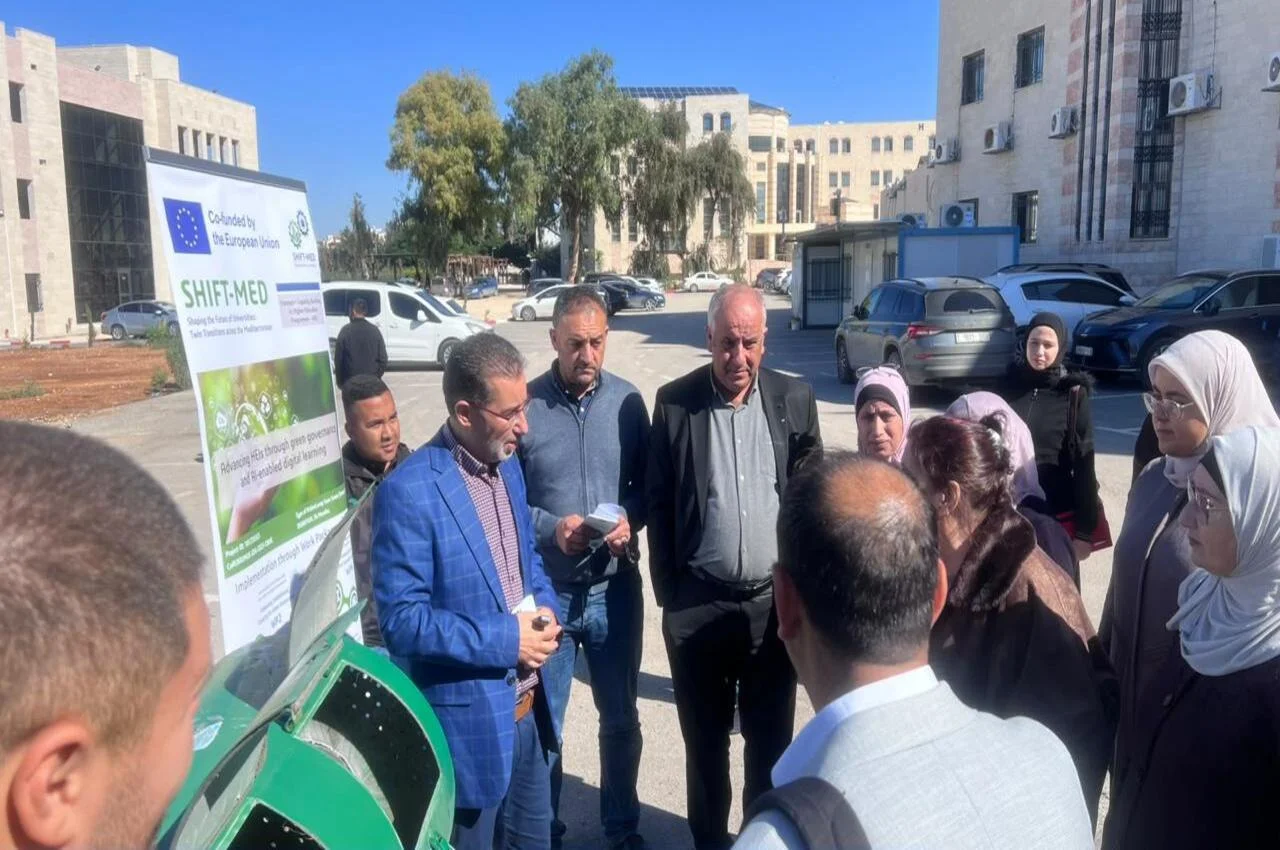
Palestine Technical University – Kadoorie (PTUK) has launched a series of activities as part of an awareness week dedicated to the concepts and objectives of the SHIFT-MED project, funded by the European Union under the Erasmus+ Capacity Building in Higher Education (CBHE) programme. The initiative features a range of interactive environmental activities and training sessions, organized in partnership with the Environmental Education Center of the Evangelical Lutheran Church in Jordan and the Holy Land, and in cooperation with the Student Council and the Student Youth Movement. The activities form part of the project’s efforts to promote green and digital transformation, build institutional capacities, and embed sustainable practices in higher education institutions and local communities.
The activities are being held under the project, which is coordinated at PTUK by Dr. Rana Samara. Attendees included project committee members Dr. Ahmad Ammar, Dr. Yahya Istitieh, Dr. Basel Al-Natsheh, Dr. Nawaf Abu Khalaf, Dr. Mahmoud Salah, Dr. Mahmoud Arhail, and Dr. Yamen Hamdan. Also in attendance were Dr. Osama Khalaf from the Faculty of Agricultural Engineering, and representatives of the Environmental Education Center: Mr. Abdul Basit Khalaf, Forums Coordinator, and Mr. Issa Ishtayeh, Mushroom Cultivation Trainer. Around 40 students and women from the Kadoorie Environmental Forum and the Anabta Women's Forum also took part.
Dr. Ahmad Ammar opened the activities by welcoming attendees and announcing the launch of SHIFT-MED Awareness Week. He stressed the importance of this phase in introducing the project’s objectives and translating its goals into practical activities that raise environmental awareness and encourage the adoption of sustainable practices. He noted that the week marks the beginning of a series of specialized workshops and activities to be held in the coming period, addressing various aspects of green and digital transformation. These activities are expected to broaden participation, promote the exchange of knowledge and expertise, and create opportunities for community partnerships that contribute to achieving the project’s objectives and sustaining its impact.
Dr. Yahya Istitieh then outlined the strategic dimensions of SHIFT-MED, explaining that it is being implemented through an international partnership involving academic institutions from countries across the Mediterranean basin. The 36-month project aims to strengthen the capacities of higher education institutions and enhance their ability to respond to environmental and technological changes. He explained that the project focuses on two complementary tracks: the first promotes green governance and the development of sustainable institutional practices, while the second advances digital transformation and the integration of modern technologies and artificial intelligence into education. He also highlighted the project's role in building academic and administrative capacities, facilitating knowledge exchange among partner institutions, and strengthening universities' contributions to addressing environmental challenges and keeping pace with technological developments.
The programme included a specialized workshop on compost production. Dr. Mahmoud Arhail from the Faculty of Agricultural Engineering delivered a presentation on the organic materials used in composting, the stages of production, and the environmental conditions required for successful decomposition. He also highlighted the importance of compost in improving soil fertility, reducing organic waste, and promoting sustainable agriculture. The presentation was followed by a field tour during which participants learned about compost production units and how they operate.
As part of the sustainable agriculture activities, Mr. Issa Ishtayeh, Mushroom Cultivation Trainer at the Environmental Education Center, conducted a training session on oyster mushroom cultivation. The session covered the preparation and sterilization of the growing substrate, the incubation period, and the conditions required for healthy growth. Participants also took part in a practical activity in which they planted mushroom samples, which they will continue to care for throughout the growing stages. The training aimed to equip participants with productive skills that could be applied in small home-based projects.
Dr. Osama Khalaf from the Faculty of Agricultural Engineering discussed the principles of home garden care and preparation for the winter growing season. He presented methods for preparing soil, selecting suitable crops, applying intercropping techniques, and using organic pest control. He also highlighted how these practices can improve household food production and make sustainable use of available space and resources.
Mr. Abdul Basit Khalaf, Forums Coordinator at the Environmental Education Center, delivered a presentation on fundamental environmental concepts and principles. Topics included biodiversity, climate change, pollution, recycling, bird ringing, sustainability, and carbon footprint. He emphasized the role of environmental awareness in strengthening individual and collective responsibility for protecting the environment and its resources.
These activities reflect SHIFT-MED’s practical approach to linking green transformation concepts with environmental and productive practices. They also broaden the reach of environmental awareness initiatives and draw on academic and community expertise, helping foster an institutional culture of sustainability and enabling participants to apply the knowledge and skills they acquire in their daily lives and community initiatives.
The awareness week is part of the project's implementation activities, which aim to strengthen the capacities of higher education institutions and promote the integration of environmental sustainability and technological innovation through specialized programmes and local and international partnerships. These efforts are intended to advance green and digital transformation and expand its institutional and community impact.