Portal | HRM | Email | LMS | Exam | Procedures Manual | Student Exchange | Repository | Research Journal | Jobs | 


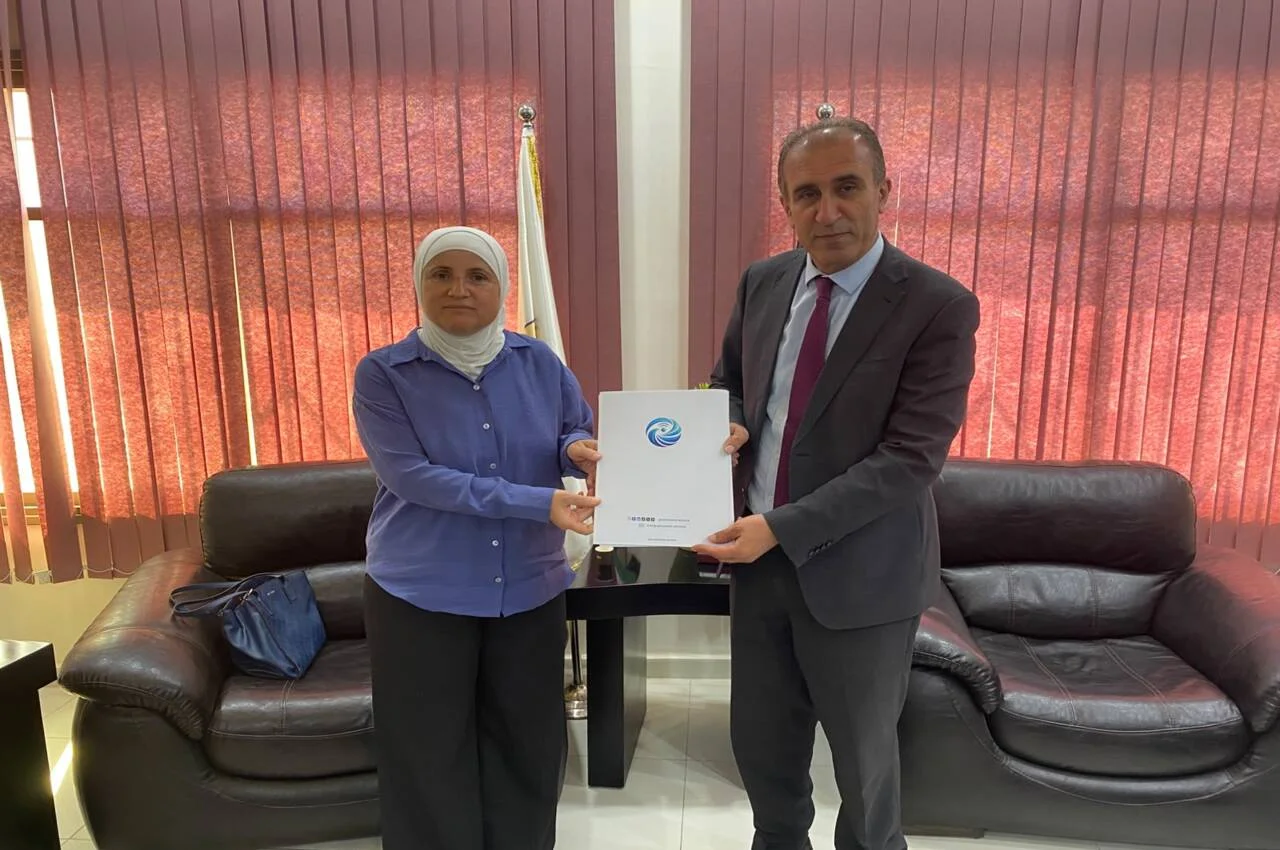
Palestine Technical University – Kadoorie (PTUK) has signed a strategic cooperation agreement with the AirAware Network project, becoming the first Palestinian academic institution to officially join the national community-based smart air quality monitoring network. The partnership reflects a growing commitment to leveraging technology and scientific research to address environmental and developmental challenges.
The signing ceremony took place at the University’s main campus in Tulkarm, where the agreement was signed on behalf of PTUK by Prof. Hussein Shanak, President of the University, and on behalf of the project by Chief Executive Officer Eng. Tawfiq Saleh. The event was attended by Ms. Nadia Khudari, National Coordinator of the Global Environment Facility Small Grants Programme (GEF-SGP), representing the project's funding body.
Representing the University were Dr. Mutamid Khatib, Vice President for Academic Affairs, Dr. Abdul Karim Jallad, Acting Director General for Agreements and Partnerships, as well as several deans and heads of relevant academic departments. The AirAware Network delegation also included Eng. Mohammad Shreim, Deputy CEO for Technical Affairs.
In his remarks, Prof. Hussein Shanak described the agreement as a model of effective collaboration between academic institutions and national technology initiatives. He emphasized the University’s readiness to dedicate its scientific and research capabilities to supporting applied projects with tangible environmental and societal impact. He also praised the project’s innovative and technological dimensions, highlighting its contribution to environmental awareness through data-driven knowledge and advanced digital solutions.
For her part, Ms. Nadia Al-Khudari reaffirmed the continued support of the United Nations Development Programme for high-impact environmental initiatives that generate sustainable outcomes. She commended the efforts of the project team from the early development stages through operational deployment and stressed the importance of utilizing technology and innovation to address environmental challenges and improve access to reliable environmental data.
During the meeting, Eng. Tawfiq Saleh presented the national vision behind the AirAware Network project, explaining that the initiative aims to establish a smart monitoring system for air quality across different regions and provide reliable environmental data to researchers, policymakers, and specialized institutions. Such data will support the development of evidence-based environmental and public health policies. He also expressed appreciation for the cooperation and support provided by the University’s administration and academic community in establishing this strategic partnership.
Meanwhile, Eng. Mohammad Shreim delivered a technical presentation outlining the project's infrastructure and technological framework. He highlighted the smart sensing technologies used to collect environmental data and demonstrated how artificial intelligence and machine learning are employed to analyze information and forecast environmental indicators. He also presented the project’s future plans for expanding the digital platform and strengthening its research and operational capabilities.
As per the agreement, an advanced air quality monitoring station will be installed on the University campus and integrated into the national environmental monitoring network. The station will provide a direct source of environmental data that can be utilized in scientific research, applied studies, and student graduation projects, while enabling researchers to examine pollution levels and air quality trends through accurate real-time field data.
As part of strengthening academic and scientific cooperation, the University nominated Dr. Nashat Jallad, Dean of the Faculty of Information Technology and Artificial Intelligence, to serve on the project’s advisory committee. His participation will contribute specialized expertise in artificial intelligence, machine learning, and data analytics to support the network’s future development and innovation efforts.
The agreement is expected to create valuable opportunities for PTUK students to engage in practical training and scientific research in areas such as artificial intelligence, the Internet of Things (IoT), data analytics, and environmental technologies. Students will also have opportunities to participate in innovation competitions and technical challenges related to environmental sustainability and emerging technologies.
In addition, the partnership will foster collaborative research between the University and the project team to develop innovative environmental data-driven models and applications, while encouraging students and researchers to participate in applied projects that contribute to sustainable development.
For the AirAware Network project, the agreement represents an important step toward expanding the national monitoring network through the addition of a new monitoring station on campus and by benefiting from the specialized expertise available at the University. This collaboration is expected to enhance the scientific credibility of the network and support the development of advanced technological solutions in environmental monitoring and data analysis.
The AirAware Network project is implemented by the Seeds for Development and Culture Association with funding from the Global Environment Facility Small Grants Programme (GEF-SGP) under the United Nations Development Programme (UNDP). The project aims to establish a smart and open national network for monitoring air quality and providing real-time environmental data to support scientific research, informed decision-making, public health, and environmental sustainability.
The signing of this agreement highlights the importance of collaboration between universities and emerging technology initiatives and reflects the role of academic institutions in leading environmental innovation and advancing knowledge-based solutions that contribute to a more sustainable and resilient future.