Portal | HRM | Email | LMS | Exam | Procedures Manual | Student Exchange | Repository | Research Journal | Jobs | 


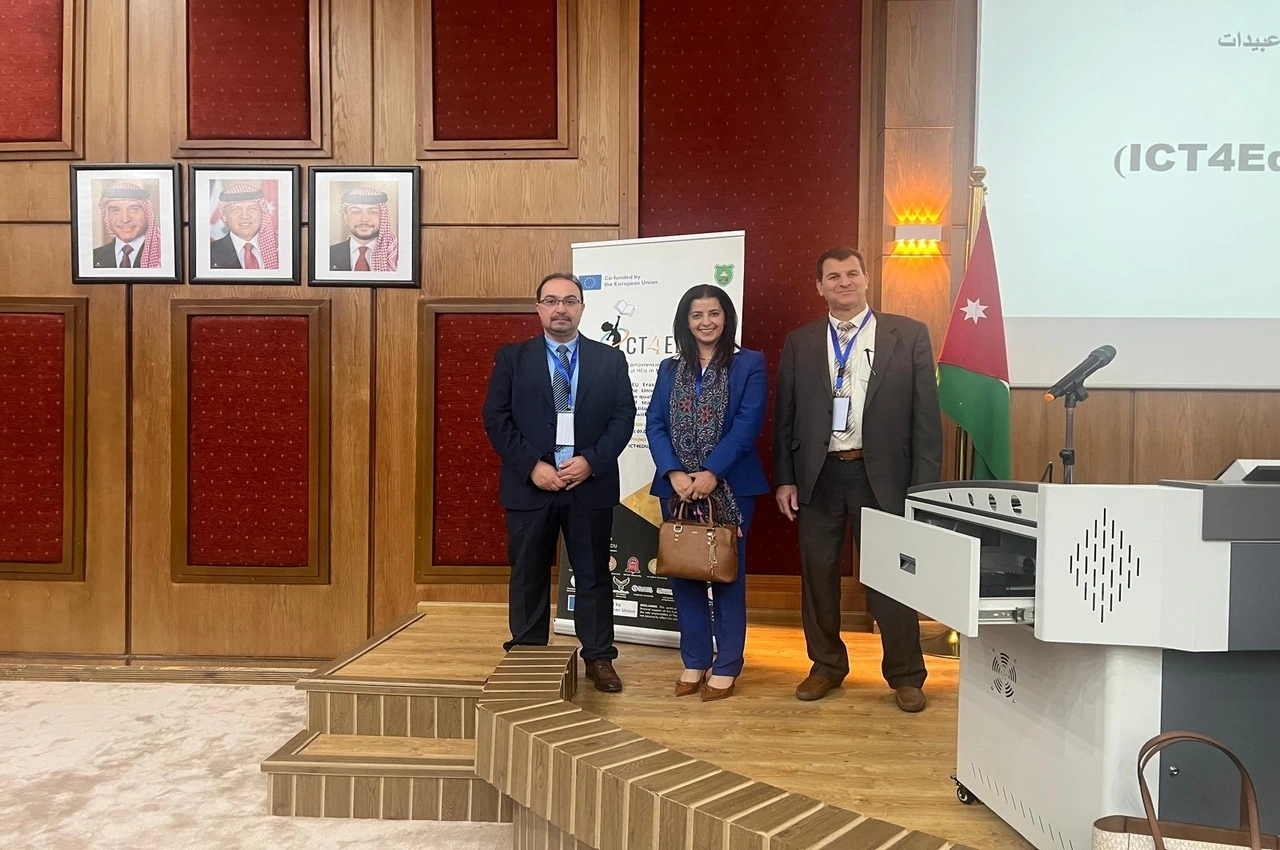
Palestine Technical University–Kadoorie participated in the final conference and administrative meeting of the ICT4EDU international project, represented by Dr. Mahmoud Jazar, Dr. Jaafar Abu Sa’a, and Dr. Nadia Hamad.
The project aims to develop early childhood teachers’ competencies in information and communication technology, with support from the European Union through the Erasmus+ program, and participation from Arab and European universities.
Dr. Mahmoud Jazar presented a detailed overview of the project’s key achievements, outcomes, and its impact on the local and international educational environment.
He affirmed PTUK’s commitment to fostering a modern educational environment that keeps pace with digital developments, considering the university’s participation in ICT4EDU a practical step toward developing early childhood programs and integrating technology into teaching according to international best practices.
Dr. Jazar explained that the project served as a platform for exchanging expertise and opened broad opportunities for building effective partnerships that contribute to improving the quality of education and developing the skills of students and teachers. He highlighted the project’s role in updating curricula, strengthening digital culture, and enhancing students’ readiness for the labor market.
The EU representative in Jordan, Prof. Ahmad Abu Al-Haija, stressed the importance of achieving a balance between digital and traditional education, especially in early childhood education.
The conference reviewed the achievements of the Erasmus+ program in Jordan and Palestine, which included dozens of projects and thousands of academic mobility opportunities, with a special focus on ICT-related projects.
Palestinian and Jordanian universities also praised the partnership with the European Union and its role in supporting academic exchange and the internationalization of education.
Regional project coordinator, Prof. Ahmad Al-Salaymeh, presented the main project results, including the updating of several university courses, the establishment of technical centers, the equipping of modern laboratories, and the implementation of training programs in several European countries, with aspirations to expand the experience and formally integrate it into educational programs.
The conference sessions discussed innovations and challenges in digital education, including artificial intelligence, cybersecurity for children, digital empowerment, curriculum development, and digital resilience, aiming to support quality and sustainability in education in the digital era.